Quick Tip 5: Use a Smaller Memory Card
From the archive
This article was originally published in 2009. Some photographs from this period were prepared at lower resolutions for the web and may appear softer or pixelated on modern screens.
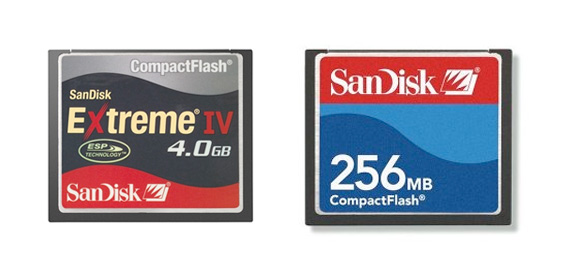
Which memory card would you put in your camera out of the two above? It seems an obvious choice, the 4.0GB. Not always, think again.

One of the drawbacks with digital is often quoted as one of its great strengths; you can shoot as much as you like and it doesn’t cost a thing. The problem with this is that we can become lazy in our image making – there’s always another shot and another and so it goes on. In the days of film it wasn’t thus. If I was taking the 5×4 field camera out I would load 10 dark slides, giving me 20 shots. 20 shots for the whole day! The care taken for each one was immense and you didn’t press the shutter until you knew everything was right from the composition and lighting to the exposure. It was a discipline and one we’ve tended to lose in the digital age. Get it back by taking a smaller card with you, limiting your days work to just a few images – you’ll be surprised at the quality of the results. On my D200 the 256MD card gives me about 42 shots, the 4.0GB in the region of 700. Get back to the discipline of really working a shot, slow down a little and so much of your technique and image construction will improve!
0 comments
I absolutely agree with you. Another advantage of a smaller card for me is that I delete shots that are far from perfect on the spot. It means that I don’t bring home 500 photos only to choose 20 good ones and 5 great ones. Less headache in front of the computer :)
I think your phrase ‘far from perfect’ is the key here. There are always those images when you know you have simply got it so far wrong that to delete is fine. You do need to be careful. however, in deleting images in the field – It’s easy to delete the wrong one and sometimes the light makes it really difficult to assess images on location. A good idea is to work both visually and with the additional information the camera can give you, particularly the histogram.